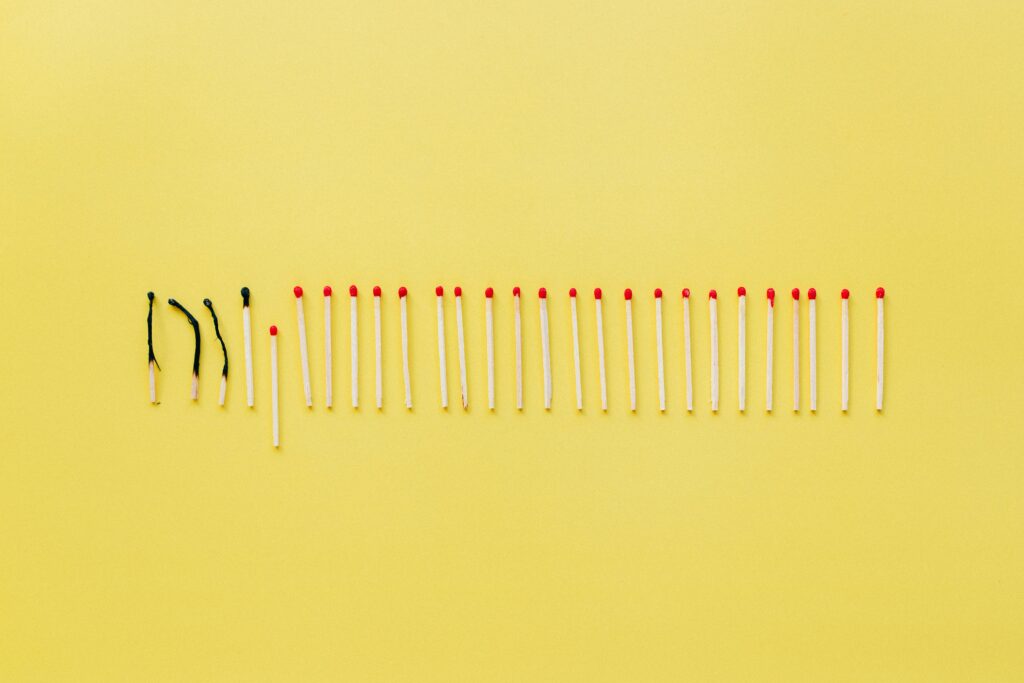
A burnout: it can happen to anyone
Everyone experiences tension and stress from time to time. For example, when moving to a new home, taking care of a sick loved one, or when things aren’t going well at work. This is normal. But sometimes, it becomes difficult to cope with the stress. You start to feel increasingly tired, have trouble staying organized, and begin canceling appointments. Eventually, you can become so exhausted that you develop burnout.
What is burnout?
Burnout is the result of experiencing too much stress over a long period of time. You feel completely “burned out,” both mentally and physically. You lose interest in everything, feel down, and have trouble reading or concentrating. Physical symptoms may also appear, such as headaches, stomach pain, high blood pressure, or dizziness. The symptoms vary from person to person. If you experience multiple symptoms for more than six months, a doctor may diagnose you with burnout.
What causes burnout?
Burnout isn’t caused by work alone. It can also stem from difficult life events, illness, or certain personal traits, such as perfectionism or insecurity. If you don’t know how to cope with these challenges and don’t receive proper support, your body won’t get the chance to recover. Over time, this can lead to burnout, often without you realizing it right away.
Which stage are you in?
The burnout working group of the NIP has created a model that outlines the different stages a person may go through before developing burnout. Can you recognize which stage you are in right now? And what do you need to avoid reaching the final stage and instead start feeling rested again?
You might hope that your symptoms will go away on their own, but unfortunately, that is often not the case. Ask for help if you can’t figure it out on your own.
Do you notice that a colleague often seems tired or tense? Talk about it and offer support. For someone feeling this way, it can be difficult to recognize their own symptoms.
Experiences from colleagues
Arfidah Beset
Business Process Engineer Poultry
Arfidah has now been working at JBT Marel for four years. Before that, she worked through a staffing agency. During that time, she experienced burnout. In this interview, she openly shares how it started, what helped her recover, and what she does differently now in both her work and personal life.
When was the moment you thought, “I can’t go on anymore”?
“That happened at my previous employer, a staffing agency. I always said yes to every assignment. As long as I was busy, I felt okay. But often, I was given work that didn’t allow me to use my energy in a meaningful way. It was below my skill level, and I wasn’t challenged enough.
I pushed my body way too hard and kept going no matter what. I started getting sick more often, with symptoms like migraines, dizziness, and an inflammation in my inner ear. My husband had taken a course about burnout and recognized many of the signs in me. Still, I didn’t believe it could happen to me—until one day, during a walk, I suddenly started crying. My body was just completely exhausted.
Eventually, I called my manager: I really couldn’t go on anymore.”
What did your recovery process look like?
“My manager and I agreed that I should focus mainly on resting and sleeping a lot. I tried walking, but it didn’t help much. The occupational health doctor was a great support. He said: ‘You have burnout, but this will be an important learning experience. You’re going to get to know yourself better.’
I started trying new hobbies, like cooking, baking, and doing creative activities. Not all at once, but step by step. I had always been so hard on myself—my to-do list was endless. So, I started small: one task a day and letting go of the idea that I had to do so much.
I also talked with a therapist through my doctor and went to yin yoga classes. The yoga, in particular, brought me a lot of peace. I learned to appreciate my body instead of being angry at it. I now understand that my body had been sending signals for a long time, but I kept ignoring them. My mind might want to do all kinds of things, but if my body can’t handle it, that’s where it stops.
At a certain point, I started working again. I decided to go from 40 to 36 hours a week to create more balance. I noticed that sometimes I really just needed to sleep to regain my energy.
After an assignment that didn’t suit me very well, I got the opportunity to start at JBT Marel, with the prospect of a permanent position later on. When I officially left my old employer, I realized my burnout was truly over. It wasn’t just the work itself that had drained me, but also the way my previous employer treated me. When I broke free from that company, I felt liberated.”
What was the most important thing for you in your recovery?
“Acceptance. Realizing that I needed to acknowledge my limits and appreciate everything my body does for me. And I learned: don’t fight your burnout. With the right help and support, things will get better. You truly get to know yourself, and in the end, you come out stronger.”
What insights did this period give you?
“My burnout was caused by my previous job and employer, combined with my personality traits—not by my personal life. I doubted my abilities, was a perfectionist, feared failure, and didn’t want to disappoint anyone.
Now I know that my opinion matters and that setting boundaries is very important. I notice more quickly when I’m tired and stop earlier. I’ve also learned that not everything has to be perfect. Doing something at 80% is often already good enough. Realizing that gives me peace of mind.
By taking smaller steps and speaking up more often, I’ve gained more self-confidence. Thankfully, my manager supports me in this. I feel valued and seen again.”
What do you do differently now in your work and personal life?
“I’ve become stronger. I dare to set boundaries, stand up for myself, and share my opinion. I also set smaller goals and allow myself to rest when my body needs it. In addition, I do more things that give me energy, like baking and sewing clothes.”
What advice do you have for colleagues dealing with (long-term) stress and tension?
“Don’t keep pushing yourself at 110% all the time. Take a step back every now and then. Otherwise, 110% will start to feel like 100%, and no one can keep that up. Appreciate your body for what it can do and make time for yourself.”
Femke Versluijs
HR Business Partner
Femke has been working at Marel in the HR department since July 2019. At the end of 2023, she experienced burnout. In this interview, she shares how it started, what helped her during recovery, and what she does differently now in both her work and personal life.
When was the moment you thought, “I can’t go on anymore”?
“During a friends’ weekend in November 2023, things went wrong. We were sitting together as a group when a new activity was announced. I started sweating, my heart was pounding, and all the energy drained from my body. I had no idea what was happening. Later, I learned it was a panic attack. My body had pulled the emergency brake.
For a long time, I had been asking a lot of myself, both at work and in my personal life. On top of that, ‘and we keep going’ had unconsciously become an important life motto for me, which meant I rarely paused to reflect on my emotions or the signals my body was giving me.
Burnout symptoms often come from a combination of factors. In my case, it was mostly about how I handled my work and personal life, combined with my personality traits. I have a strong sense of responsibility, set very high standards for myself, and found it difficult to say no—qualities that caused me to put a lot of pressure on myself.
Looking back, I realize I ignored many symptoms: hot flashes, painful joints, muscle twitches, and fatigue. I even underwent several medical tests at the hospital, but nothing was found. Physically, I seemed healthy. No one—including myself—connected my symptoms to stress.
The moment my body finally said stop came during a period when I was actually experiencing more calm and space in my life. Once there was room to breathe, the symptoms surfaced.”
What did your recovery process look like?
“In the first few months, I was completely exhausted—mentally and physically—and I also experienced cognitive issues. There was a period when I thought: How will I ever get out of this? That time became an important turning point for me. It was then that I realized I was stuck in a vicious cycle of stress, symptoms, and fear, and that it was crucial to break free from it.
At the beginning, I focused mainly on rest: I slept, practiced yoga, and did breathing exercises. Once I regained a bit more energy, I started going for walks. In addition, I sought professional help. I worked with a coach through my job, a haptonomist, and a psychotherapist.
I came to understand that rest alone wasn’t enough. It was essential for me to become aware of my behavioral patterns and beliefs—and to actively work on breaking them.”
What was ultimately the most important thing for you in your recovery?
“In the beginning of my burnout, I put a lot of pressure on myself to recover. I wanted to get better as quickly as possible and was constantly searching for the magic solution to heal. This actually backfired and caused even more stress.
As time went on, I realized there is no quick fix for recovering from burnout. Letting go and accepting the situation was an important step—and at the same time incredibly difficult. Some days I handle it better than others.
I began to see my recovery as a puzzle. To heal, you need different pieces, and that realization brought me peace. It doesn’t all have to happen at once. I also learned the difference between external and internal stress. Taking rest may relieve external pressure, but not the internal pressure. Your thoughts, the expectations you place on yourself, and the suppression of emotions also create stress. For me, it was essential to work on those internal factors.”
How are you doing now?
“My recovery hasn’t been a straight line. I have good days and not-so-good days, but I now understand that this is part of the process. I’ve learned a lot about myself and can even look back with gratitude.
I’m working part-time again, doing fun activities in my personal life, and gradually finding more balance. I trust that I will fully recover and regain the freedom to live without constantly thinking about what I can or cannot do.”
What do you do differently now in your work and personal life?
“I focus much more on balance and rest. In the past, I would completely fill up my schedule. Now, I consciously choose what I will and won’t do. I take more time to reflect on my feelings and listen to my body.
I’m also very open about my situation with family, friends, and colleagues. This creates understanding and allows me to feel supported. I’m very grateful for the help and care I’ve received from them.
It has helped me a lot to hear and read about other people’s experiences. That’s also why I chose to do this interview. During my recovery, I found great value in the book Over de kop by Brankele Frank. She’s a neurobiologist who has experienced burnout twice. In her book, she explores what burnout really is and shares her personal story. It was very relatable and comforting to know I wasn’t alone.”
What advice would you give to colleagues dealing with (long-term) stress and tension?
“It might sound a bit abstract, but it’s important to pay attention to your feelings and the signals your body is giving you. I realized mine far too late.
If I had listened earlier, I might have been able to prevent it. Don’t wait too long to ask for help, because it’s not easy to go through this alone—and you don’t have to. If you wait until your body pulls the emergency brake, recovery can take a very long time.”
Josien van den Bosch
Supply Chain Planner
Josien has been working at JBT Marel since 2011 and is a mother of two children. Two and a half years ago, she experienced burnout. In this interview, she shares how she went through that period and the insights it has given her.
When was the moment you thought, “I can’t go on anymore”?
“Three years ago, I went through a divorce and moved several times in a short period. After the second move, about two and a half years ago, I was completely drained. I was at work when I realized I could no longer read the texts on my screen. I could see the words, but they just wouldn’t register. My head was full, and my ‘computer’ crashed.
I called my manager and reported sick. My doctor immediately said I had burnout. At first, the company doctor didn’t fully grasp how serious my symptoms were. From the outside, you couldn’t really tell anything was wrong. For example, I didn’t cry when I talked about it and could still put on a smile. It wasn’t until I went through further testing with my doctor that the severity became clear.
For years, I had just kept pushing forward. Looking back, I now realize I had been on the edge of burnout several times before. For instance, I had three and a half years of broken nights with my youngest child. It didn’t feel right to call in sick because of that—work wasn’t responsible for my lack of sleep. I kept telling myself, ‘These symptoms will go away once things calm down.’ But there was always something going on.
On top of that, my role as a Supply Chain Planner comes with a lot of responsibility. I enjoy it, but it’s also busy and dynamic. We have constant communication with colleagues from various departments and suppliers. There are many balls to keep in the air and priorities to manage. At a certain point, it all just became too much, and my mind shut down.”
What did your recovery process look like?
“My doctor and I created a plan together. The first step was to write down everything that had happened in recent years and figure out what had led me to this point. It’s like putting together a puzzle, and at the same time, you have to learn to accept the situation. That was hard and took time to process.
When therapy started, things actually became even more difficult, and I hit rock bottom. But from there, I was able to rebuild.
We had initially agreed that I would continue working a few hours from home, but that didn’t work out well. I didn’t want to sit at home alone—work and my colleagues were actually a welcome distraction. My manager supported my wish to come into the office for a few hours each week.
However, the open office space was overwhelming. The noise and constant stimuli quickly made me tired and dizzy, and I couldn’t talk to someone for long without feeling drained. Eventually, we made arrangements like: “On Tuesdays and Thursdays, this quiet desk is reserved for Josien.” Thankfully, my colleagues were very understanding.
It’s hard to relate to someone going through burnout because you can’t see it on the outside, but we were able to talk about it openly. That support meant a lot to me, and I received so much help from my colleagues.
In total, it took me fourteen months to fully recover. I gradually built up my hours step by step. JBT Marel really supported me throughout this process and carefully considered what I needed at each stage. I’m incredibly grateful for that.”
What was most important to you in your recovery?
“Breaking my fixed patterns and truly doing things differently. I had to step out of my comfort zone because those patterns had led me to burnout in the first place.
For example, I used to struggle with setting boundaries and lowering my expectations of myself. By discussing this with my JBT Marel coach and my manager, and practicing through role-playing, I’ve gotten much better at handling these situations.”
What insights has this experience given you?
“Change starts with yourself. It’s important to understand what led to your burnout so you can break the patterns behind it. For me, one key step was learning to set boundaries. For example, sometimes hour-long meetings were scheduled, but I couldn’t handle that. It was hard to speak up about it, but I did it anyway because I knew it would help me in the long run. The first time was difficult, but after doing it five times, you realize, ‘This really helps me,’ and it starts to feel easier.
I’ve also learned not to be afraid to ask for help. After being officially cleared to return to work, I still felt I wasn’t fully recovered. So, I reached out to HR for support. They advised me to work with a reintegration coach from MEPD. With this coach, I discussed specific situations at work that I found challenging and learned strategies to handle them. That guidance was incredibly valuable to me.”
How are you doing now?
“It’s been about a year and a half since I was officially declared recovered, but I’ve realized that burnout never completely disappears. The ups and downs are still there, but now there’s more time between them. About once every two months, I have a moment where I think, ‘I can’t handle this right now—it’s too much.’
The difference now is that I understand where those feelings come from and what I can do about them. I can piece the puzzle together much faster. And I’m very clear with myself: I will never go back to how things were.
During my recovery, it was difficult to accept when I wasn’t doing well. Now, I know what actions to take so the feeling fades more quickly and I can get back into a positive flow.”
What do you do differently now in your work and personal life that makes a difference?
“I’ve learned to better sense my boundaries. I notice stress signals earlier now: rapid breathing, dizziness, and restlessness in my mind. When I feel those, I know I need to slow down and make space for rest. If something doesn’t feel right, I take it seriously and set my boundaries. It’s still challenging, but with practice, it becomes easier.
In my personal life, I also do things differently. When someone asks me for something, I don’t immediately say yes. Instead, I say, ‘Let me think about it.’ This gives me space to decide whether I really want to do it—because even fun activities can become overwhelming.
If I know a busy period is coming, I make sure my schedule is clear afterward. I leave room for spontaneous plans instead of filling up my calendar. That brings peace of mind. I’ve also learned what helps me recharge, like listening to music or going for a walk to clear my head.”
What advice would you give to colleagues dealing with (long-term) stress and tension?
“Dare to face the challenge—especially with yourself—and don’t take work home with you. At first, it might feel scary, but it gets easier and will only benefit you. By practicing this, the barrier has become much lower for me.
It can be as simple as moving to another workspace if your current one is too noisy or busy. The easiest thing to do is stay put and think, ‘It’ll be fine, just a few more hours,’ but instead, get up and try a different spot. That small change can break the pattern. Or pull a colleague aside for a private conversation to address something that’s bothering you. Otherwise, you’ll take those feelings home with you.
And most importantly: seek help early! If your manager can’t help you, go to your doctor, the company doctor, or HR. They can help you figure out how to deal with it.”
Martin Papjes
Mechanical Engineer
When did you realize you were experiencing burnout?
“I’d been dealing with vague complaints for several years — constant fatigue, feeling worse over time. I’d had several medical checkups, but nothing showed up. Eventually, I started doing my own research and realized I could tick almost every box for burnout symptoms. My doctor confirmed the diagnosis. That moment really felt like failure — as if I hadn’t pushed hard enough to get through the rough patch. I thought it would eventually pass on its own. My motto had always been ‘giving up is not an option.’
My close circle had seen it coming for a while, though, and they were very understanding. JBT Marel and the occupational health physician also responded quickly and gave me the time and space I needed to recover gradually.”
What caused it?
“The passing of my uncle in Canada at the beginning of 2021 was the final straw for me. Organizing the funeral remotely (during COVID) while also dealing with stressful hospital admissions within the family took a big emotional toll. The symptoms I already had only got worse from that point.”
Can you share a key turning point?
“I had been tired for a long time and struggled to truly rest. I still exercised, but that only drained me further. I no longer felt satisfaction in the things I usually enjoyed. I used to joke that my ‘battery needed replacing.’ I slowly became more and more overloaded. Catching up on sleep didn’t help, and everyday tasks took more energy than I had. I would work late into the evenings at home just to meet deadlines — leaving no room to recharge. I’m also quite a perfectionist, which only increases the risk of burnout.”
What did you do to recover?
“I gave myself plenty of rest and focused on doing things that actually gave me energy. The dark, rainy winter months were tough, but I kept skating and mountain biking — at about a third of my usual pace, but still. I needed to rediscover the joy of being at the rink or in the forest, instead of focusing on speed or performance. After a few months, I started a training on perfectionism. It was confronting, but it gave me valuable insights — especially how to recognize early warning signs and prevent slipping back into old patterns.”
What worked well for you? What didn’t?
“Finishing long-term projects, letting go of certain tasks, and not having to perform for a while really helped me recover. I also found it helpful to return to the office part-time rather than working from home full-time. Relaxing with music or light meditation also worked well for me.
When too much piles up for too long, you have to make choices. You can’t keep all the balls in the air. It’s better to finish a few things properly than to do many things halfway.”
How are you doing now?
“Since early December 2022 I’ve been working full-time again and back in the daily routine. But in terms of energy, I’m definitely not fully recovered yet — that takes longer. I need to rest when my body tells me to and manage my energy carefully. I can’t join in on everything yet and have to pace myself, including with sports.”
How have you experienced this period, and what insights has it given you?
“I never realized how many physical symptoms come with the lead-up to burnout. The recovery also takes much longer than you expect. The longer you’ve drained yourself, the longer it takes to rebuild.”
What do you do differently now, at work and in your personal life?
“I focus on fewer things at once. What needs to happen now, and what can wait? It’s important to sense this and speak up when you need to slow down. I listen to my body, ease off when necessary, and take regular breaks. To maintain that balance, you have to recognize the signals and ask for help early — before falling back into old habits.
There’s a saying in speed skating: ‘Winners win through balance and rest.’ Working harder doesn’t always lead to the best results!”
What would you say to colleagues who are dealing with (long-term) stress or tension?
“Pace your energy, take breaks on time, and make room for enjoyable relaxation. Pay attention to how physical symptoms develop and take a look at the signs of burnout — how many can you tick off? I wouldn’t wish such a period on anyone, so learn to recognize the warning signs and take care of your mental and physical wellbeing. Prevention is always better than recovery.”